
Day in the Life of an AV Technician with Jack Gregory
When a meeting room works exactly the way it should, most people do not think about what happened behind the scenes.
The display turns on.
The audio is clear.
The camera frames the room.
The call connects.
The meeting starts.
But behind that simple experience is a lot of planning, coordination, installation, testing, and problem-solving.
For this feature, we spoke with Jack Gregory, AV Technician at CaTECH Systems, to better understand what a typical day looks like on site and what it really takes to bring modern workplace AV installations to life.
His answers highlight the human side of technical work:
early mornings, jobsite coordination, constant learning, and the pride that comes from building systems people rely on every day.
The day often starts before the city wakes up
For many AV technicians, the workday begins early. As Jack puts it, a typical day can start with an alarm as early as 4:30 a.m., followed by coffee and a quieter drive to site while the city is still waking up. Once on site, the pace shifts quickly.
Cable runs.
Equipment mounting.
Loading and unloading material.
Working around other trades.
Coordinating with contractors.
Solving installation challenges as they come up.
No two days look exactly the same.
“You often start a day with an idea of what it will consist of,” Jack says, “but you can never quite anticipate the variables a job site can offer.”
That unpredictability is part of what makes the role challenging and also what keeps it interesting.
Bringing the design to life
A successful AV installation starts long before a technician arrives on site.
There is design, planning, coordination, procurement, scheduling, and client communication. But eventually, all of that planning has to become something real.That is where the AV technician plays a critical role.
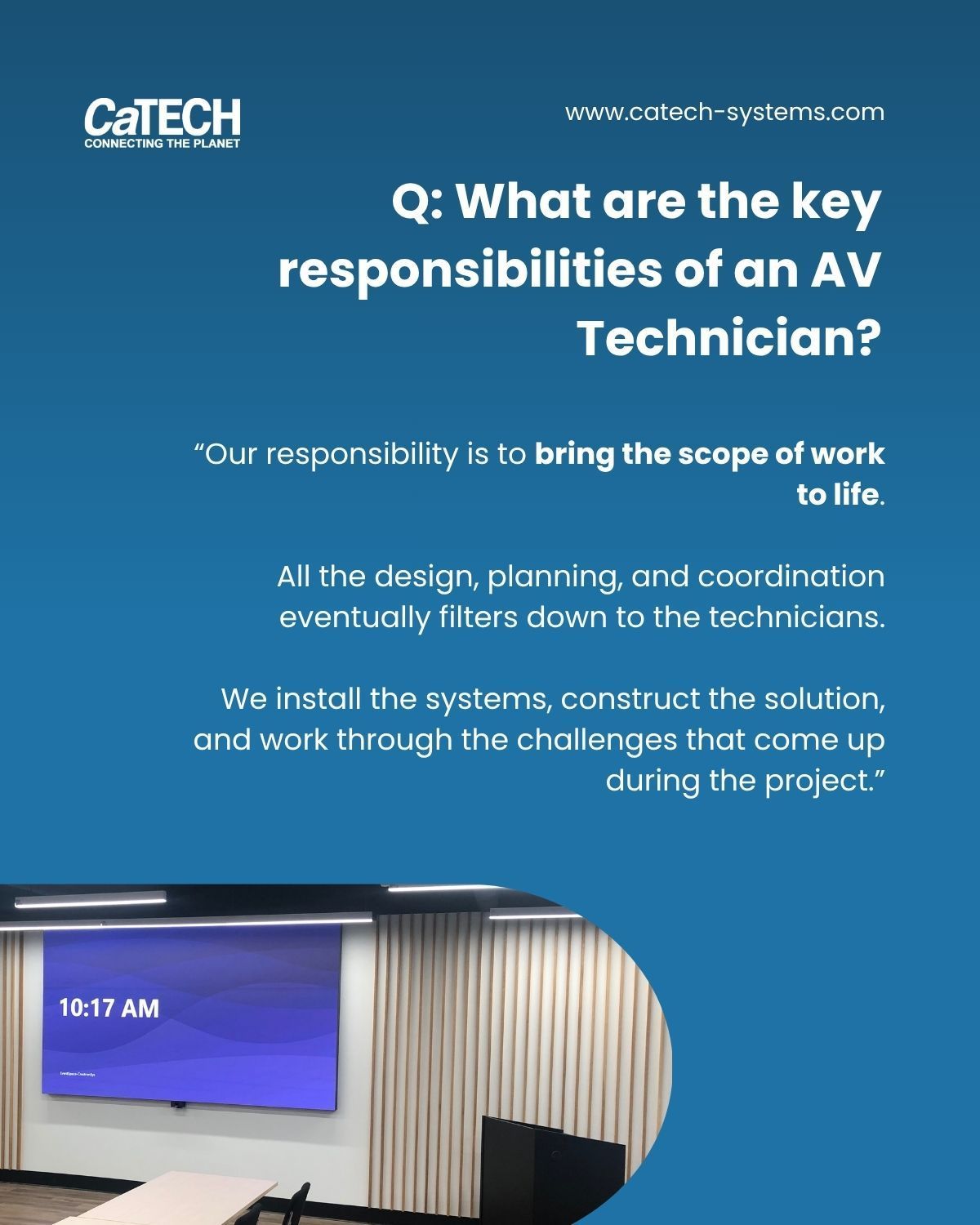
- “The key responsibilities of a technician revolve around executing the scope of work,” Jack explains. “It is our job to bring the scope of work to life.”
In practical terms, that can include:
- Installing displays and mounting hardware
- Pulling and routing AV cabling
- Setting up speakers, microphones, cameras, and control systems
- Coordinating with electrical, construction, IT, and other trades
- Testing systems before handover
- Troubleshooting issues on site
- Making sure the finished installation aligns with the client’s expectations
For Jack, the role is not just about installing equipment. It is about turning a design into a working environment that people can use confidently.
- “All the designing, planning and coordinating filters down to the technicians,” he says. “It is our job to execute the plan, construct the systems, install the material and overcome any installation challenges.”
AV work depends on teamwork
Commercial AV installation rarely happens in isolation. On any active jobsite, there may be multiple trades working at the same time — construction teams, electricians, network teams, ceiling contractors, furniture vendors, designers, project managers, and client stakeholders.That makes coordination one of the biggest factors in project success.
- “In our industry, working collaboratively is so important,” Jack says. “On a jobsite there are dozens of trades working alongside each other to complete their scope of work.”
This is where experience matters. An AV technician has to understand not only the AV system, but also the larger site environment. Site conditions can change. Timelines can shift. Access may be limited. Other trades may need the same space at the same time.
Jack points to site conditions and coordination as some of the biggest challenges technicians face.
For clients, this is one of the most important behind-the-scenes realities to understand: a smooth AV experience at the end depends on strong coordination during the build.
The best AV technicians lead with attitude
Technical skill matters in AV. But according to Jack, one of the most important qualities is not a tool or certification. It is your attitude.
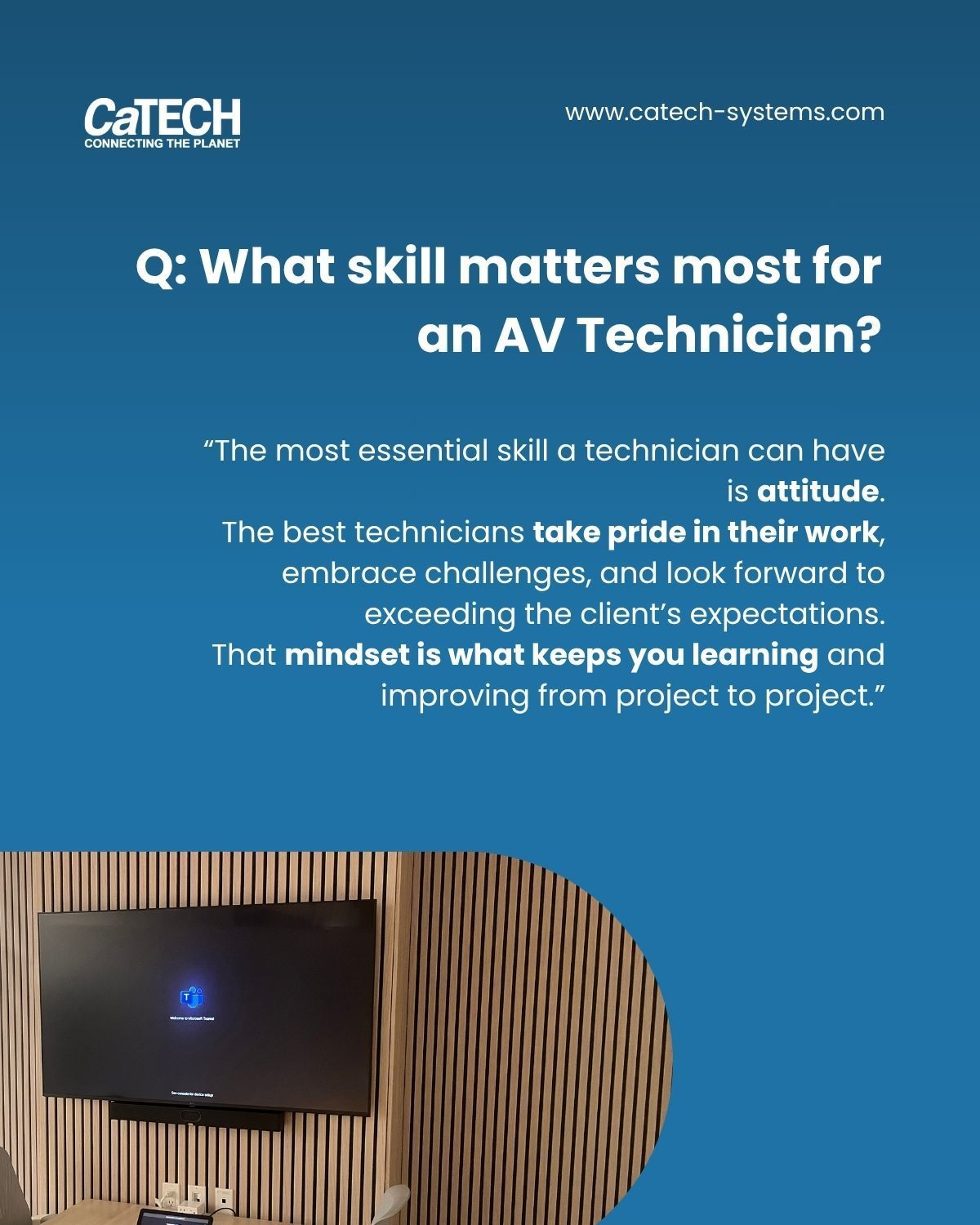
- “The most essential skill a technician can possess is their attitude,” he says.
Jack describes the best technicians as people who embrace challenges and use them as motivation.
- “They take pride in their work and look forward to exceeding the client’s expectations,” he says. “They embrace challenges and use them as fuel for the job satisfaction they’ll receive when they conquer the inherent challenges our industry forces them to embrace.”
That mindset matters because AV work can be unpredictable. A technician may be working with new products, old construction, new construction, tight timelines, or site conditions that require quick thinking. The job rewards people who are patient, adaptable, and willing to keep learning.
The tools go far beyond screwdrivers and drills
AV technicians use many familiar tools: screwdrivers, drills, pliers, ladders, lifts, and mounting equipment.
But modern AV work also requires specialized tools and technical knowledge. Depending on the project, technicians may use:
- Fibre termination tools
- Network scanning tools
- Cable testing equipment
- Heavy concrete drilling tools
- Mounting and alignment tools
- Labeling and documentation tools
- AV configuration and testing equipment
This mix of construction skill and technical troubleshooting is one of the reasons AV technician work is so unique.
It sits at the intersection of physical installation, networking, workplace technology, and user experience.
The AV industry keeps changing
The audio-visual industry is evolving quickly. Meeting rooms are no longer just spaces with a screen and speakers. Today’s workplaces often need integrated systems that support hybrid meetings, collaboration platforms, cameras, microphones, control systems, touch panels, wireless presentation, room scheduling, and more.
As technology improves, some installation tasks become more streamlined. But expectations also rise.
Newer AV systems are capable of delivering better user experiences — and that means technicians need to keep growing with the technology.
- “The audio-visual industry is in a constant state of rapid evolution,” Jack says. “The evolving audio-visual ecosystem compels us to learn and grow with it.”
That continuous learning is part of the job.
For businesses, it also highlights why choosing the right AV integration partner matters. Modern AV installations are not just about putting hardware in a room.
They require people who understand how the system will be used, how it connects to the broader environment, and how to deliver a clean, reliable experience.
What most people never see
When people walk into a completed workplace, they usually see the finished experience.A clean display, working microphone in a polished meeting room.
But they rarely see what is behind the walls, above the ceiling, inside the rack, or hidden within the building infrastructure.
That hidden work is where much of the craftsmanship lives. Jack explains it well:
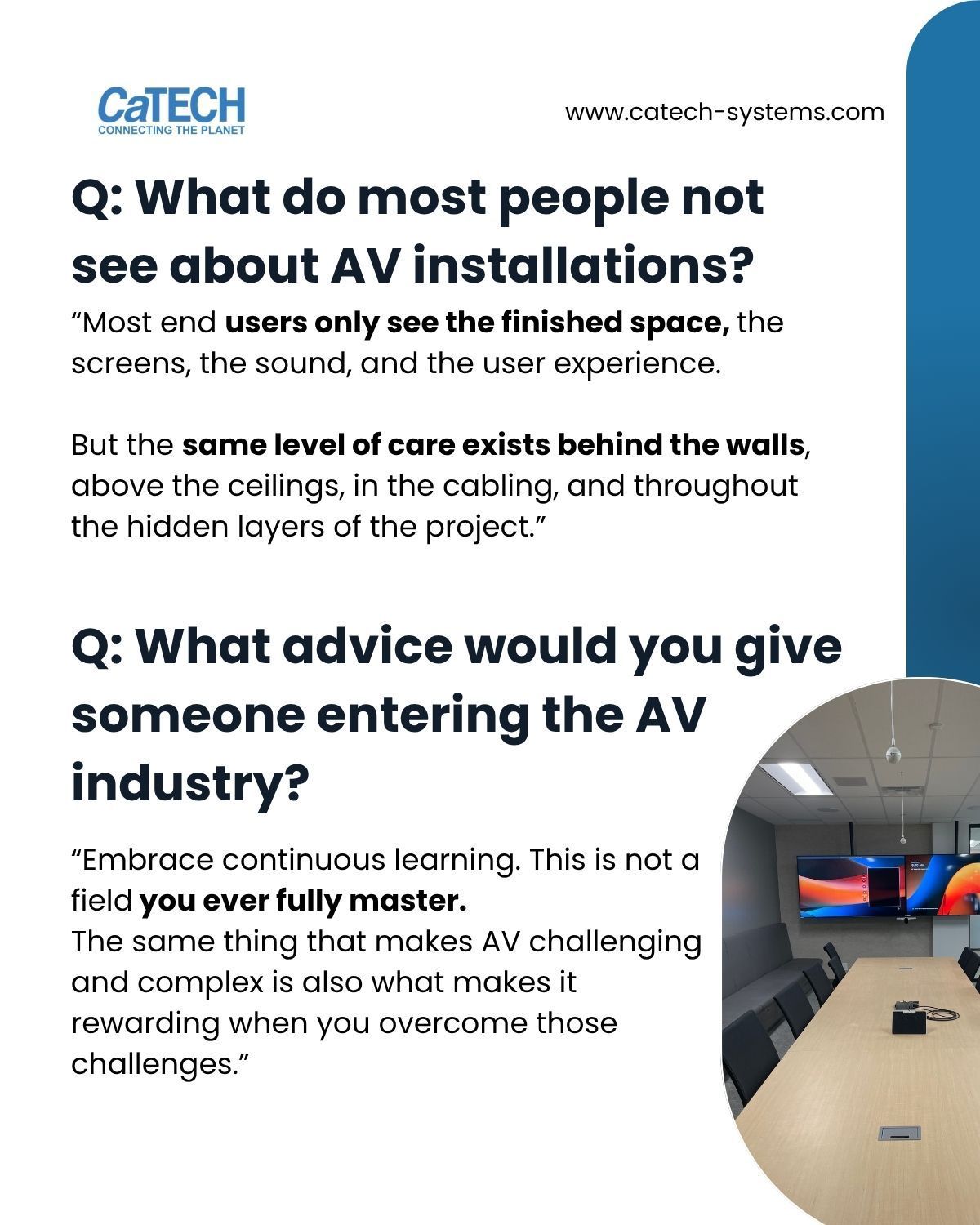
- “Most people could walk into a finished client site, look around and praise the installation quality and overall user experience. However, the end user typically only gets to witness 50% of the overall craftsmanship that goes into our installations.”
The same attention to detail visible on the surface often exists behind the scenes too — in cable pathways, rack organization, mounting, labeling, testing, and coordination with the building’s infrastructure.
That is the part most users never see.
But it is also the part that helps the technology work reliably.
Advice for anyone considering a career as an AV technician
For someone considering a career in AV, Jack’s advice is simple:Embrace continuous learning.
- “This field is not one you can ever master,” he says. “If you work towards a feeling of conquering the industry or finishing your knowledge journey, you will never be able to achieve that.”
That may sound challenging, but it is also what makes the work meaningful.The AV industry keeps changing. Each project brings new lessons. Each jobsite presents new variables. Each system pushes technicians to adapt and grow.
- “The very thing that makes the AV industry so challenging and complex is also the thing that delivers the rewarding feeling you get when challenges are overcome,” Jack says.
Final thoughts
A seamless meeting room experience does not happen by accident. It takes planning, coordination, technical skill, patience, and people who care about the details.
From early morning site starts to final system testing, AV technicians play a critical role in creating the workplace technology experiences that businesses rely on every day.
At CaTECH Systems, our AV teams bring together the hands-on skill, technical knowledge, and practical problem-solving needed to deliver modern workplace AV environments — built for performance, usability, and long-term reliability.
Because behind every seamless meeting experience, there is a team that made it work.
Whether you are building new meeting rooms, upgrading hybrid collaboration spaces, or planning a larger workplace technology rollout, CaTECH Systems can help design, install, and support AV environments that work the way your teams need them to.